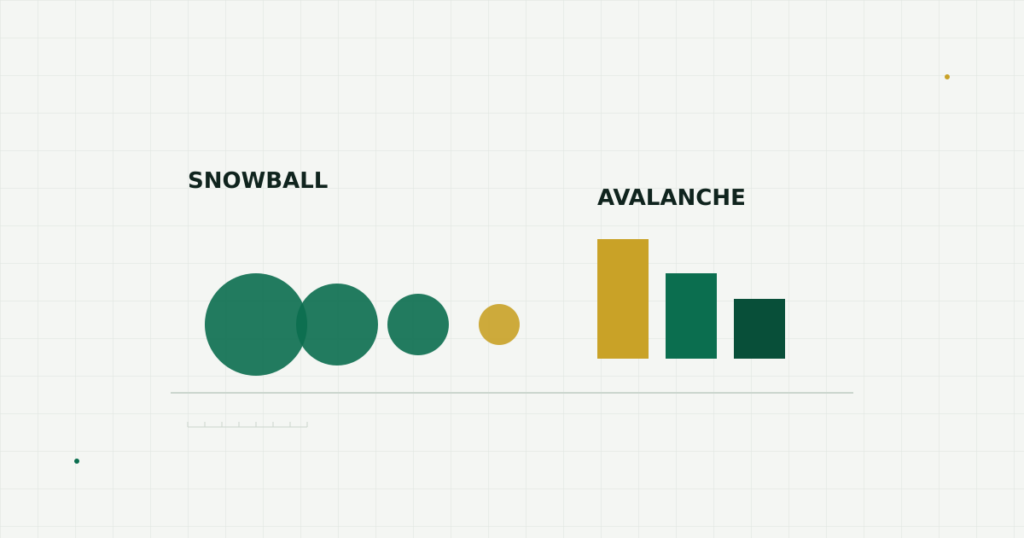
If you’re carrying more than one debt — a couple of credit cards, a personal loan, maybe a car loan — the order you pay them off in actually matters. Two strategies dominate the advice you’ll find online: the snowball and the avalanche. They’re both valid; they just optimize for different things.
The debt avalanche method
Pay minimums on everything, then throw all extra money at the debt with the highest interest rate first. Once that’s gone, roll the payment into the next-highest rate, and so on.
Why it’s mathematically optimal: you minimize the total interest paid across all your debts, because the most expensive balance shrinks fastest.
The debt snowball method
Pay minimums on everything, then throw all extra money at the smallest balance first, regardless of interest rate. Once it’s paid off, roll that payment into the next-smallest balance.
Why people prefer it anyway: knocking out an entire debt — even a small one — quickly produces a visible win. That momentum keeps a lot of people consistent in a way the avalanche method, which can feel slow at first, sometimes doesn’t.
A concrete comparison
Take three debts: a $1,000 card at 24% APR, a $5,000 card at 19% APR, and an $8,000 personal loan at 9% APR, with $400/month available beyond minimums.
- Avalanche targets the $1,000 card first (highest rate), typically saving more in total interest over the full payoff period.
- Snowball also targets the $1,000 card first here, since it happens to be both the smallest balance and the highest rate — but in cases where the smallest balance isn’t the highest-rate debt, the avalanche method will save more, sometimes by a meaningful amount.
Which one should you actually use?
If you’re confident you’ll stick with a plan regardless of early wins, avalanche saves you the most money. If you’ve tried and stalled on debt payoff before, the snowball’s quick wins are often worth the extra interest cost — a plan you actually finish beats a theoretically optimal one you abandon in month four.
Our Credit Card Payoff Calculator can model either strategy against your real balances so you can see the actual time and interest difference before you commit.