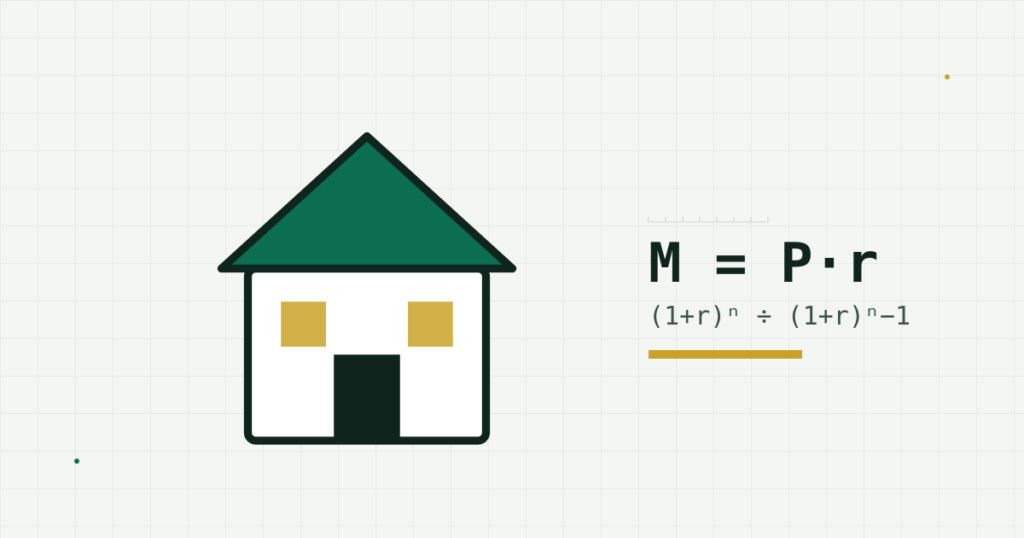
If you’ve ever wondered how a lender turns a loan amount into a monthly bill, the answer is one formula — the same one, whether you’re buying a $150,000 starter home or a $1.5 million property. Once you understand it, no mortgage offer will feel like a black box again.
The mortgage payment formula
The standard fixed-rate mortgage payment formula is:
M = P × [ r(1+r)n ] / [ (1+r)n − 1 ]
- M — your monthly principal & interest payment
- P — the loan principal (home price minus down payment)
- r — your monthly interest rate (annual rate ÷ 12)
- n — total number of monthly payments (loan term in years × 12)
A worked example
Say you’re borrowing $400,000 at a 6.4% annual rate over 30 years. That’s a monthly rate of 0.5333%, and 360 total payments. Run those numbers through the formula and you land on roughly $2,499 a month in principal and interest alone.
The three costs the formula doesn’t include
Principal and interest is only part of the bill. Most lenders — and most online calculators — also roll in:
- Property tax, usually billed annually but collected monthly through escrow
- Homeowners insurance, also collected monthly
- PMI (private mortgage insurance), if your down payment is under 20% of the home’s value
Skip these and your “estimated payment” can be off by several hundred dollars a month.
Why the term length matters more than people think
A 15-year loan at the same rate roughly doubles your monthly payment compared to a 30-year loan — but it can cut your total interest paid by more than half over the life of the loan. There’s no universally “right” answer here; it depends on how much monthly flexibility you need versus how much interest you’re willing to pay over time.
Rather than running this formula by hand, you can plug in your own numbers on our Mortgage Payment Calculator and see the full breakdown — principal, interest, tax, and insurance — instantly.