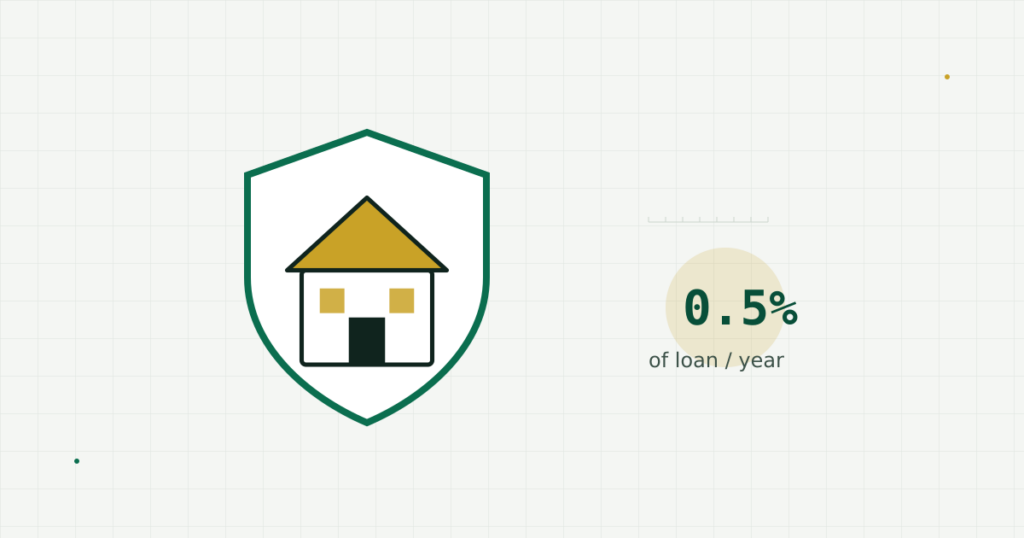
If your down payment is under 20% of the home’s price, there’s a good chance your loan estimate includes a line item you didn’t ask for: PMI. Here’s what it actually is, what it costs, and — importantly — how to stop paying it as soon as possible.
What PMI actually protects
Private mortgage insurance doesn’t protect you — it protects the lender, in case you default on a loan where they’re carrying more risk (because you put down less equity upfront). It’s standard practice on conventional loans once your loan-to-value (LTV) ratio goes above 80%.
How much PMI typically costs
PMI usually runs between 0.3% and 1.5% of the loan amount per year, split into monthly payments. On a $350,000 loan, that’s roughly $87 to $438 a month — a meaningful swing depending on your credit score and down payment size.
How lenders calculate your rate
Two factors drive the number most: your credit score and your loan-to-value ratio. A borrower with a 760+ credit score and a 15% down payment will pay noticeably less PMI than someone with a 650 score and a 5% down payment on the same loan amount.
When PMI goes away
By law (in the US, under the Homeowners Protection Act), lenders must automatically cancel PMI once your loan balance hits 78% of the home’s original value — assuming you’re current on payments. You can also request cancellation yourself once you hit 80%, which can save you months of unnecessary premiums if you don’t want to wait for the automatic cutoff.
Three ways to avoid or shorten PMI
- Put down 20% or more — the most direct way to skip it entirely
- Make extra principal payments — getting to 80% LTV faster ends PMI sooner
- Refinance once your home’s value has risen enough to clear the 80% threshold on its own
Not sure where you currently stand? Our PMI Calculator shows your loan-to-value ratio, your estimated monthly PMI cost, and exactly how much more equity you need to drop it.