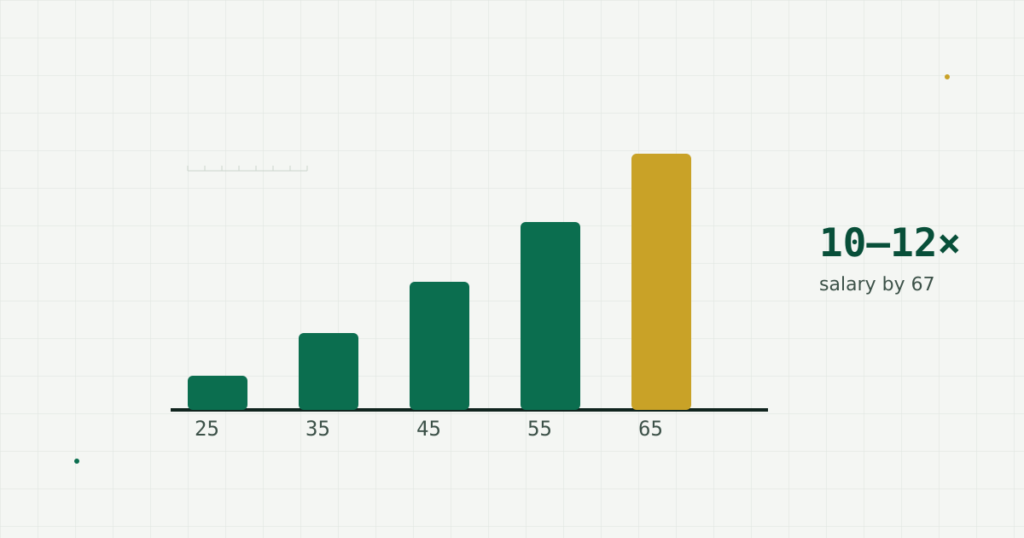
Retirement savings benchmarks get shared constantly, usually without their assumptions attached — which makes them feel either impossibly out of reach or misleadingly simple. Here’s what the common guidelines actually say, and how to use them realistically.
A common rule of thumb
One widely cited benchmark suggests having saved roughly this multiple of your annual salary by each age:
- Age 30: 1× your salary
- Age 40: 3× your salary
- Age 50: 6× your salary
- Age 60: 8–10× your salary
- Age 67: 10–12× your salary
These assume you start saving in your 20s, contribute consistently, and invest primarily in a diversified mix of stocks and bonds that adjusts more conservatively as you approach retirement.
Why these numbers don’t fit everyone
They assume a fairly standard career trajectory, no major income gaps, and a retirement age around 65–67. Career breaks, self-employment, late starts, and different retirement ages all shift these numbers — sometimes significantly. Treat them as a rough compass, not a verdict.
If you’re behind: what actually moves the needle
- Increase your contribution rate gradually — even 1% more per year compounds meaningfully over a decade
- Capture any employer match in full — leaving a match on the table is leaving guaranteed, immediate return unclaimed
- Reduce fees — a 1% difference in fund fees can cost tens of thousands of dollars over a multi-decade timeline, quietly
- Delay retirement by even 1–2 years — this both extends your saving period and shortens the number of years your savings need to cover
The single biggest lever: starting date
Two people saving the same amount monthly, one starting at 25 and one at 35, can end up with drastically different balances at 65 — often a difference of hundreds of thousands of dollars, purely from the extra decade of compounding. If you’re getting a late start, the honest fix isn’t guilt — it’s increasing your contribution rate today to partially make up for lost time.
See exactly where your current savings rate puts you using our Retirement Savings Calculator — it projects your balance forward based on your real contributions and timeline.